
Arranging a Deceased Estate Clearance in Newcastle upon Tyne can feel very different from an ordinary house clearance. You’re not simply deciding which furniture is no longer wanted. You may be dealing with family photographs, financial paperwork, jewellery, keepsakes and belongings collected over decades.
The practical work becomes much easier once the important possessions have been identified and the person responsible for the estate has decided what can be removed.
This guide explains how to approach the process carefully without making it more complicated than necessary.
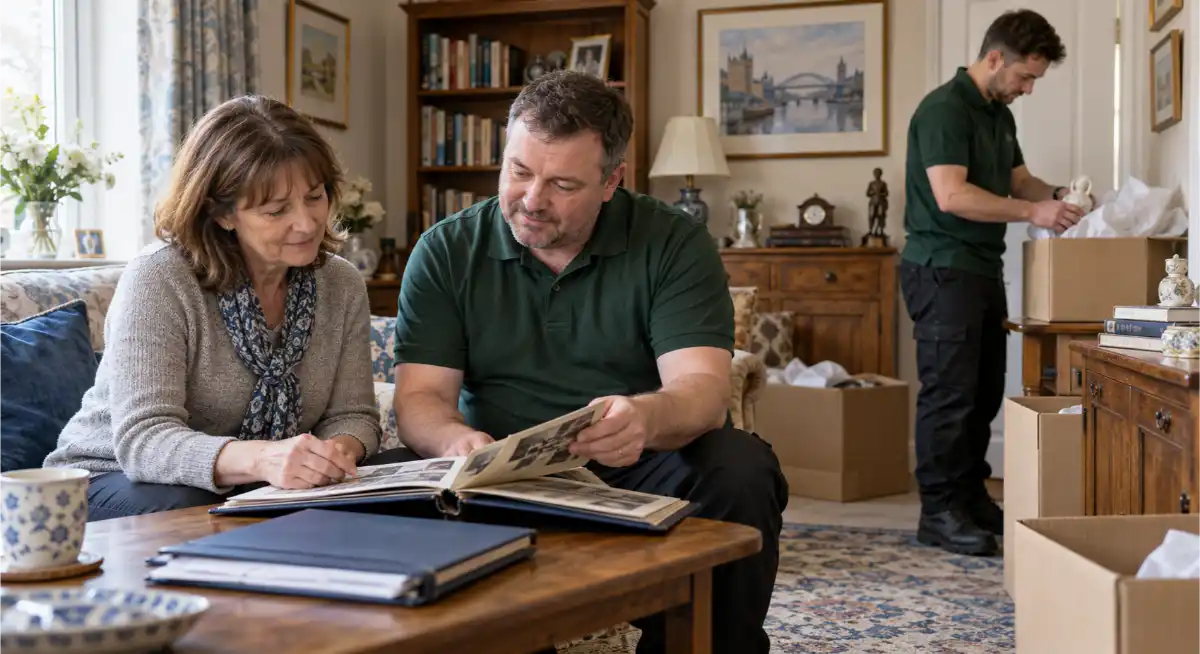
Before furniture or household contents are removed, spend time identifying anything important.
GOV.UK guidance confirms that household goods and personal belongings form part of a deceased person’s estate and should be considered when the estate is valued.
Look particularly carefully for:
- Wills and legal papers
- Property documents
- Bank and pension correspondence
- Passports and certificates
- Jewellery and watches
- Family photographs
- Letters
- Collectables
- Artwork
- Keys
- Items beneficiaries want to keep
Check cupboards, drawers, filing cabinets, coat pockets, suitcases and storage boxes.
If you’re unsure about something, put it aside rather than including it in the clearance.
Potentially valuable possessions should be considered before they’re sold, donated or removed.
The person responsible for administering the estate needs to identify its money, property and possessions. Where probate is required, the estate must be valued before the probate application is made.
Ordinary household furniture may have modest resale value, while jewellery, antiques, paintings or collectables could require closer attention.
Where full estate details are required, GOV.UK states that professional valuations can be obtained for individual possessions worth more than £1,500, while cheaper household goods can usually be estimated.
If you’re uncertain about an item, obtain appropriate advice before it leaves the property.
Services Nearby Areas:
What we offer...
You don’t need a complicated sorting system.
Use:
KEEP
Belongings being retained by family members, beneficiaries or the estate.
CHECK
Anything requiring valuation or further discussion.
REMOVE
Contents the authorised person has agreed can be cleared.
If possible, move retained possessions into one clearly identified room.
For large furniture that cannot easily be moved, use a visible label.
This helps prevent confusion once the clearance begins.
Some families only need several large pieces of furniture removed.
Others need most of the property emptied before it can be cleaned, sold or handed over.
A clearance may include agreed items such as:
- Sofas and chairs
- Beds and wardrobes
- Tables and cabinets
- Books and general belongings
- Clothing
- Suitable appliances
- Kitchen contents
- Garage belongings
- Loft contents
- Shed contents
You can also arrange a partial clearance.
There’s no need to empty the whole house simply because some rooms need attention.
Storage spaces often hold years of belongings.
A garage can contain old furniture, bicycles, tools and boxes. Lofts may be filled with luggage, clothing and household possessions that haven’t been used for a long time.
When requesting a quotation, tell the clearance company about every area you want included.
Send photographs where possible.
Adding a full garage or loft after the quotation has been prepared could significantly change the amount of work involved.
There isn’t one standard price because every home contains a different amount of furniture and belongings.
The quotation may consider:
| Factor | Why It Matters |
|---|---|
| Volume of contents | Affects vehicle space and loading |
| Number of rooms | More areas can require additional time |
| Furniture size | Heavy pieces may need more labour |
| Access | Stairs and carrying distances affect the work |
| Storage spaces | Garages and lofts can add considerable contents |
| Type of material | Certain items may require separate handling |
For a useful assessment, provide:
Postcode + photographs + rooms requiring clearance + access details.
This is generally more helpful than trying to estimate the weight of everything yourself.
Newcastle City Council provides a paid bulky waste collection service for eligible domestic household items such as sofas and fridges. It does not cover commercial items, and landlords or managing agents need to make their own arrangements.
The council also requires bulky items to be placed at an appropriate accessible collection point, normally such as the front path, driveway, bin area or back lane.
That may be suitable if only a few items need removing.
A private estate clearance may be more practical where:
- Furniture needs carrying from inside
- Several rooms need clearing
- The property contains many belongings
- Upstairs furniture requires removal
- A garage or loft is included
- The home needs substantially emptying
Choose based on the amount of practical help required rather than assuming one option suits every property.
- Ready to clear your Newcastle Property?
Take Care of the Important Things First
There’s no need to rush through a loved one’s belongings.
Identify anything important, establish what beneficiaries want and deal with possessions requiring valuation.
Once the authorised person knows what can be removed, House Clearance Newcastle can help with the practical work.
Send us:
Property postcode + photographs + areas requiring clearance + access details.
We’ll assess the requirements and provide a quotation for the agreed contents.